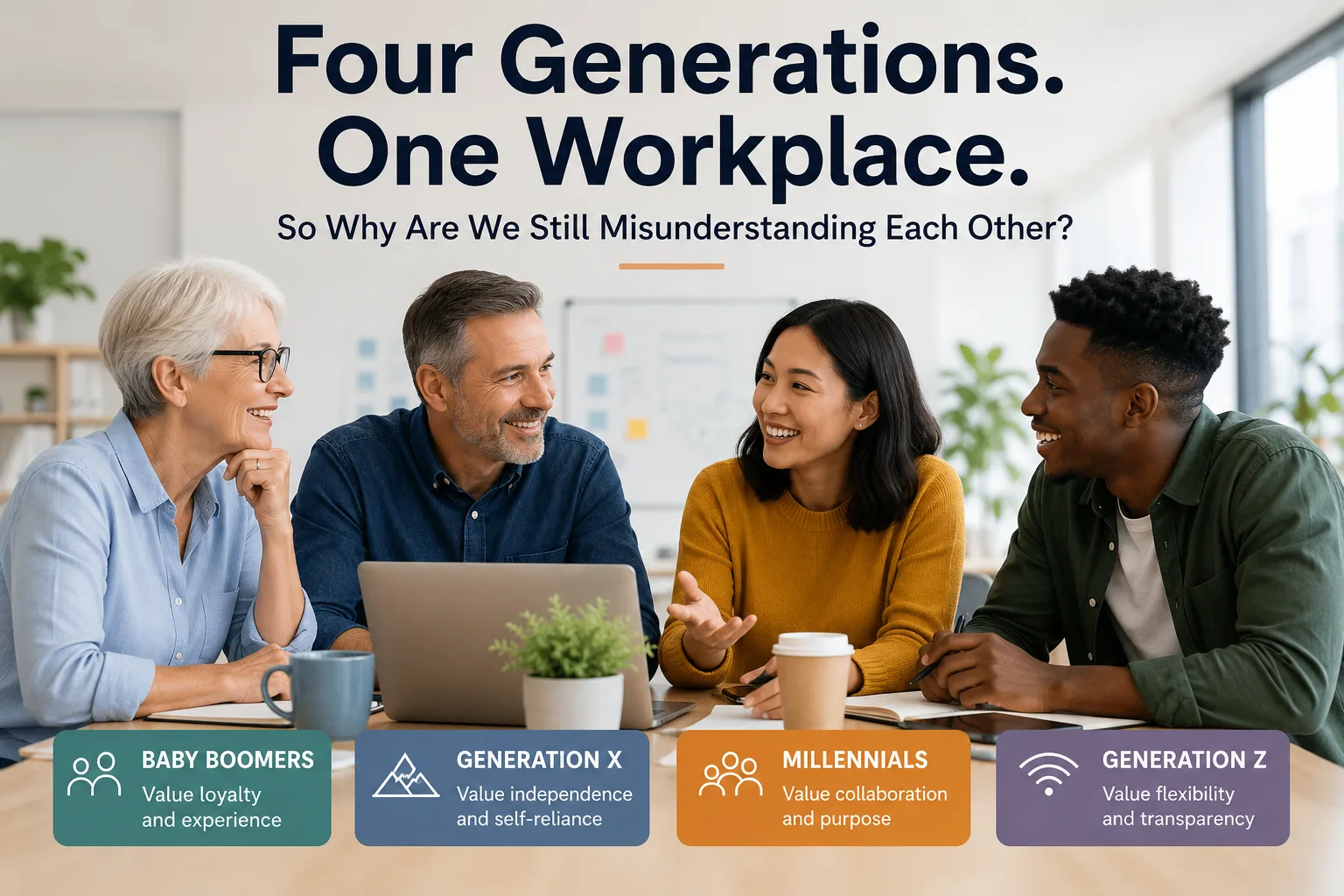
Four Generations. One Workplace. So Why Are We Still Misunderstanding Each Other?
It's Not a Generation Problem. It's a Translation Problem.
By Ola Adediji · 14 Jul 2026 · 4 min read
"I'm just asking a question."
"I'm just asking you to trust the process."
For a brief moment, the room fell silent.
No one was angry.
No one raised their voice.
Yet you could almost feel the tension hanging in the air.
I looked around the table.
The most experienced person in the room leaned back in their chair, arms crossed.
Across from them, the newest employee looked confused.
A manager glanced from one side of the table to the other, unsure whether to step in.
On paper, this was an ordinary meeting.
In reality, I was watching four generations, each shaped by a different world, trying to solve the same problem.
The experienced employee couldn't understand why every decision needed to be questioned.
The younger employee couldn't understand why asking "why" seemed to make people uncomfortable.
Neither of them was wrong.
They were simply speaking different workplace languages.
As someone who works in People and Culture, moments like this have become surprisingly familiar.
Not because one generation is harder to work with than another.
But because each generation carries a different set of experiences into the workplace.
The more I thought about that meeting, the more I realized something.
We're asking the wrong question.
For years, we've asked:
"How do we manage Gen Z?"
"Why don't Millennials stay?"
"Why are Boomers resistant to change?"
"What motivates Gen X?"
Maybe that's why we keep ending up in the same conversations.
We're looking for generational answers to what are often very human problems.
We all inherited different definitions of work
Think about the advice people received when they started their careers.
For some, success meant keeping your head down, working hard, and earning trust over years.
For others, success meant asking questions, sharing ideas, and finding purpose in the work.
Some entered workplaces where loyalty was rewarded.
Others entered workplaces where adaptability mattered more than tenure.
Some built careers before email.
Others have never known a world without instant communication, remote work, or artificial intelligence.
Of course their expectations are different.
How could they not be?
The stories we tell ourselves
Here's what fascinated me about that meeting.
The conversation wasn't just about a project.
Everyone had created a story in their head.
The senior employee thought,
"They're questioning my experience."
The younger employee thought,
"They're shutting down my curiosity."
Neither story was true.
But both stories felt true.
That's what misunderstanding does.
It fills in the blanks with assumptions.
Great leaders become translators
I've stopped trying to understand generations.
Instead, I've started trying to understand people.
I've met Gen Z professionals who crave stability.
I've met Baby Boomers who embrace change faster than anyone else.
I've met Millennials who prefer complete independence.
I've met Gen X leaders who coach every member of their team every single week.
People are always more complex than the labels we give them.
The best leaders know this.
They don't assume.
They ask.
"Tell me how you like feedback."
"Help me understand your perspective."
"What does success look like for you?"
Simple questions.
Powerful answers.
The meeting ended differently than it began
By the end of that conversation, something had shifted.
Not because everyone suddenly agreed.
Because everyone finally understood where the others were coming from.
The questions weren't about disrespect.
The caution wasn't about resisting change.
The confidence wasn't entitlement.
The patience wasn't complacency.
Different experiences.
Different perspectives.
Same goal.
One workplace. One lesson.
Today's organizations are filled with people who grew up in completely different worlds.
That's never happened at this scale before.
We can choose to see that as a problem.
Or we can see it as one of the greatest strengths a team can have.
Because innovation rarely happens when everyone thinks alike.
It happens when different perspectives learn to understand one another.
So the next time someone tells you,
"This is just a generational issue."
Pause for a moment.
It probably isn't.
It might just be two people speaking different workplace languages and waiting for someone to translate.
Maybe that's the real work of leadership.
Not managing generations.
Helping people understand each other.
Enjoyed this?
Get the next one in your inbox, or take the next step on your career.
Book a discovery call