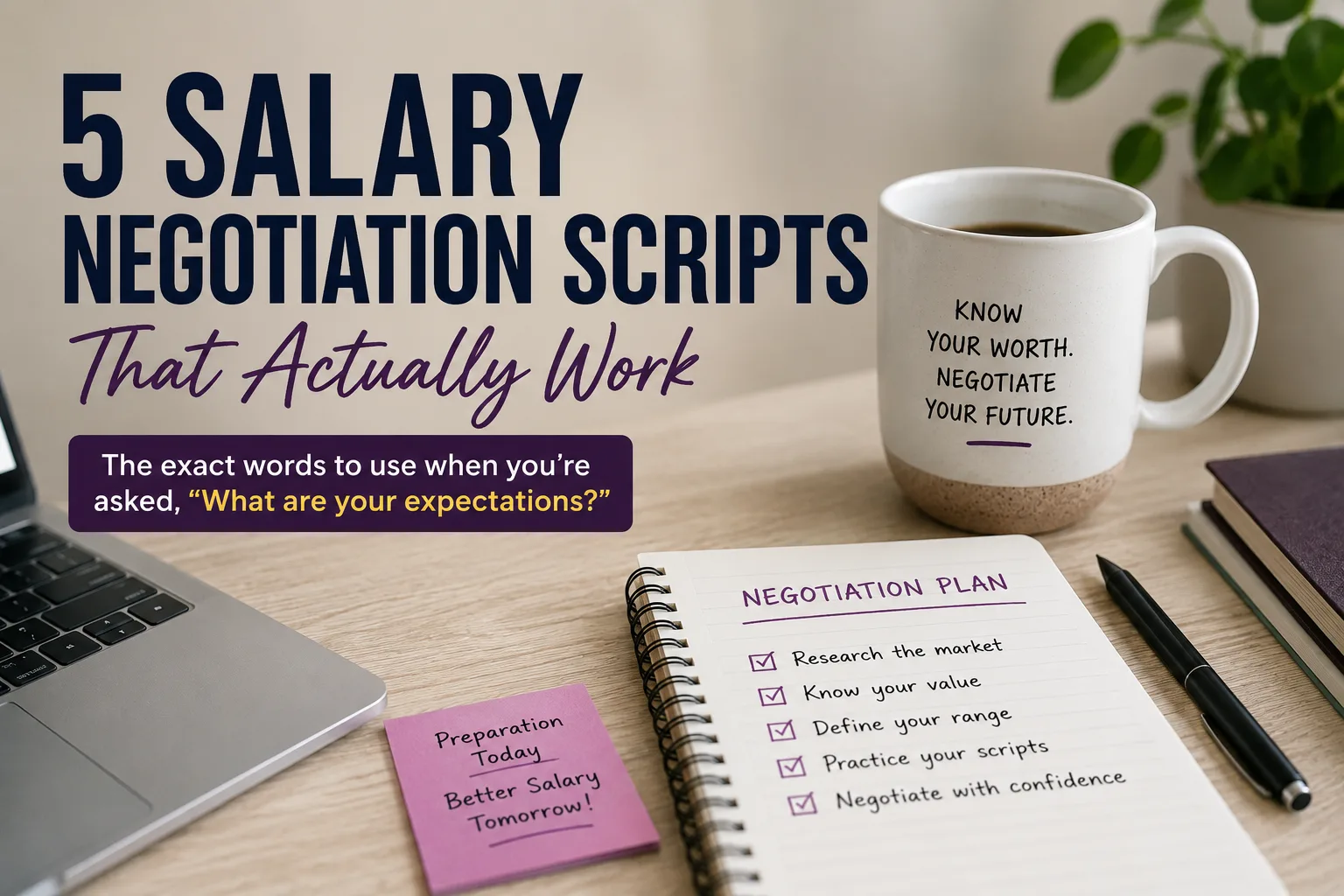
5 Salary Negotiation Scripts That Actually Work
The exact words to use when you’re asked “what are your expectations?”
By Ola Adediji · 22 Jun 2026 · 5 min read
I've sat on both sides of the table.
Over the years, I've been part of countless hiring conversations.
I've interviewed candidates, worked with hiring managers, extended offers, and helped organizations make compensation decisions.
And I've noticed something.
Some of the strongest candidates I've ever met unintentionally left money on the table.
Not because they weren't worth more.
Not because the company didn't have the budget.
But because they didn't know what to say when the conversation turned to salary.
One question would catch them off guard.
"What are your salary expectations?"
Suddenly, all the confidence they showed throughout the interview disappeared.
Some answered with a number far below market value.
Others apologized before asking for more.
A few accepted the first offer immediately, only to wonder months later whether they could have negotiated.
If you've ever been in that position, you're not alone.
The good news is this.
Salary negotiation isn't about being pushy.
It's about having the confidence to have a professional conversation.
Here are five scripts that can help.
Before we start...
Let's clear up three myths.
Myth #1: "If I negotiate, they'll withdraw the offer."
In most professional hiring processes, that's simply not how it works.
If an employer has decided you're the right person, a respectful conversation about compensation is usually expected.
It's rarely the negotiation that causes concern.
It's the way someone negotiates.
Myth #2: "I should give the first number."
Not necessarily.
Whenever possible, learn the employer's range first.
You can't negotiate effectively without understanding where the conversation starts.
Myth #3: "Negotiating makes me look greedy."
Not when it's done professionally.
Good employers don't expect you to undervalue yourself.
They expect you to understand your market value and communicate it respectfully.
Script 1
When they ask for your salary expectations
Instead of immediately giving a number, try this:
"I'm really excited about the opportunity and I'd love to learn a little more about the role before discussing compensation. Would you mind sharing the salary range that's been budgeted for the position?"
Why this works
Many employers already have an approved salary range.
By asking first, you're gathering information instead of negotiating against yourself.
Script 2
When they insist on a number
Sometimes they'll politely ask again.
If that happens, try this:
"Based on my experience, the responsibilities of the role, and what I've seen in the market, I'm targeting somewhere between $95,000 and $105,000. Of course, I'd also want to consider the overall compensation package."
Why this works
You're providing a thoughtful range rather than locking yourself into one number.
It also signals that you're considering the full package, not just salary.
Script 3
When the offer is lower than expected
One of the biggest mistakes candidates make is accepting immediately because they're worried about losing the offer.
Instead, pause.
Thank them.
Then say:
"Thank you. I'm genuinely excited about the opportunity. Based on my experience and the value I believe I'll bring to the role, I was hoping for something closer to $105,000. Is there any flexibility?"
Why this works
It's collaborative.
You're not making demands.
You're inviting a conversation.
Script 4
When they say, "That's our best offer."
Sometimes that really is the highest salary they can offer.
That doesn't necessarily mean the conversation is over.
You could respond with:
"I understand. If salary isn't flexible, would there be flexibility around professional development, additional vacation, hybrid work arrangements, a signing bonus, or an earlier salary review?"
Why this works
Compensation is more than salary.
Many organizations have flexibility in other parts of the package even when base pay is fixed.
Script 5
When you need time before accepting
You don't need to make a decision on the spot.
Try saying:
"Thank you very much for the offer. I'm genuinely excited about the opportunity. I'd appreciate a day or two to review everything carefully before making my decision. Would it be alright if I got back to you by Friday?"
Why this works
Thoughtful decisions are professional decisions.
Most employers expect candidates to take a little time.
Here's one mistake I see more often than you'd think.
Candidates explain why they need more money.
"I have a mortgage."
"My rent has gone up."
"I have childcare expenses."
While those reasons are completely understandable, they're usually not what employers base compensation decisions on.
Instead, focus on the value you bring.
For example:
Instead of:
"I really need another $10,000."
Try:
"Based on my experience leading similar work and the value I believe I can bring to the team, I was hoping we could explore a salary closer to..."
That shifts the conversation from your personal circumstances to your professional contribution.
One important exception
Not every role has room for negotiation.
Some organizations have structured salary grids.
Others have collective agreements or fixed pay bands.
Government and public sector roles, for example, may have limited flexibility depending on their compensation policies.
Even then, it never hurts to ask thoughtful questions about the overall package or future salary progression.
My biggest piece of advice
Prepare for the salary conversation the same way you prepare for the interview.
Research the market.
Know your target number.
Know the minimum you'd realistically accept.
And most importantly, practise saying the words out loud.
Because confidence rarely appears by accident.
It comes from preparation.
One final thought
The biggest negotiation isn't actually about money.
It's about believing the experience you've spent years building has value.
Employers negotiate budgets every day.
Projects get negotiated.
Contracts get negotiated.
Vendor agreements get negotiated.
There's nothing unprofessional about negotiating your career with the same level of preparation and respect.
You don't need to be aggressive.
You don't need to be uncomfortable.
You simply need to be prepared.
And that one conversation could change what you earn for years to come.
Enjoyed this?
Get the next one in your inbox, or take the next step on your career.
Book a discovery call